
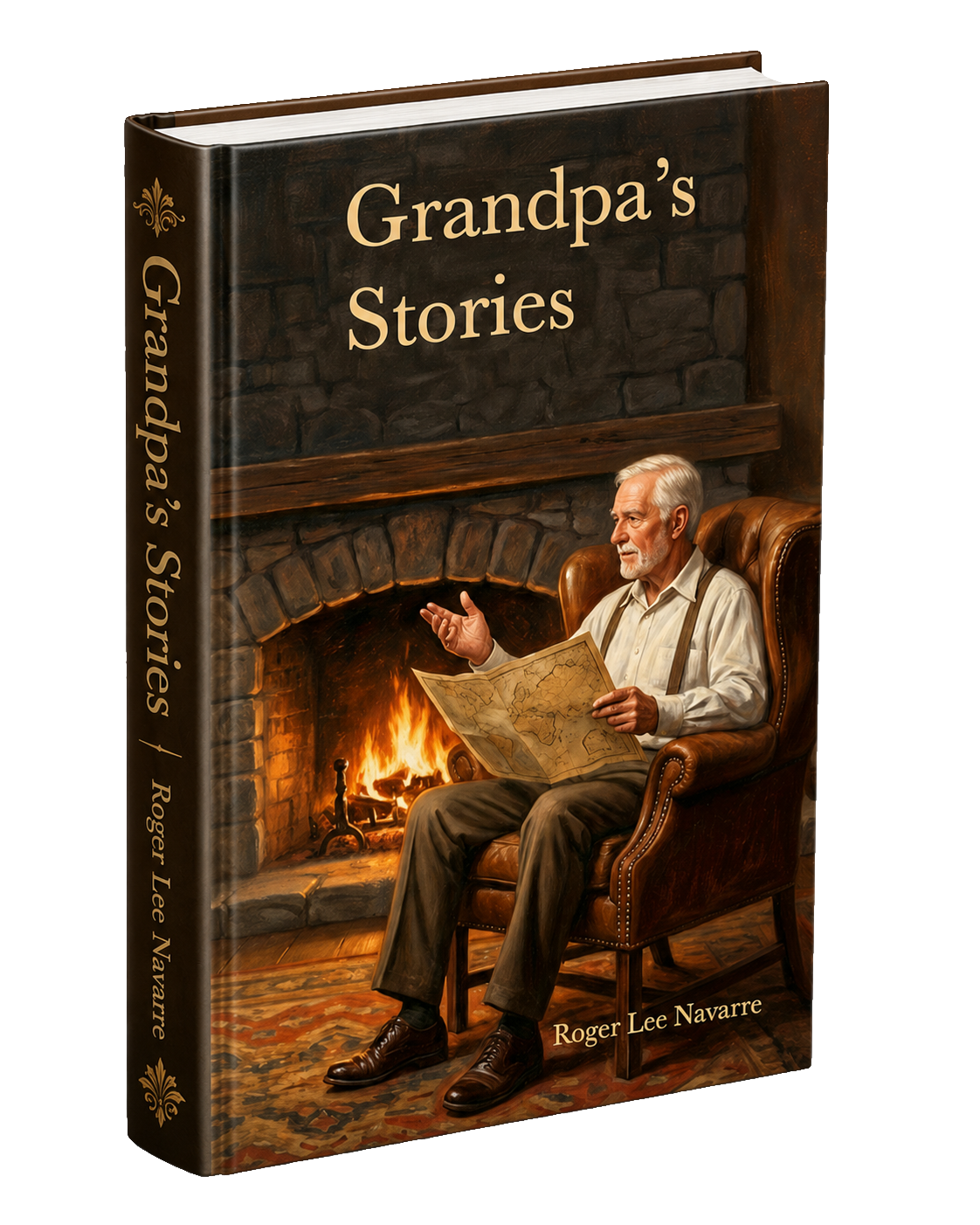
Grandpa's Stories
Family Lore
During several visits to Grandpa's house his grandchildren hear stories about their Navarre family ancestors.
- Genre
- Family lore
- Formats
- Paperback
- Release date
- May 1, 2025
Not commercially available.
Formats
Available formats
Paperback
Available now
Release date: May 1, 2025
Available now to family members and other interested parties
From the book
Read an excerpt
The Confrontation at Mackinac
The following week brought a break in the cold. The temperature had risen just enough to turn the snow to slush, and a gray, heavy sky promised more precipitation to come. But Grandpa’s study was warm and bright, the fire crackling cheerfully, and when the grandkids arrived, they found him already deep in his notes, several books spread open around him.
He looked up as they came in, and there was an intensity in his eyes they’d rarely seen.
“Sit down,” he said, not waiting for them to settle. “I’ve been thinking about this story all week, about how to tell it right. Because what happened in 1763—what your ancestor said and did—it’s one of those moments that defines a life. That shows you who a person really is.”
They took their usual spots quickly, sensing the energy in the room.
“Let me set the scene,” Grandpa began, and his voice dropped into that storytelling register immediately. “It’s 1763. The French and Indian War has just ended. The British have won, and suddenly they control all the forts and trading posts in the Great Lakes region. Everything the Ojibwe have known for generations—the French alliance, the familiar traders, the established relationships—it’s all gone. Swept away.”
He stood, pacing slightly. “And the Ojibwe are scared. The French had understood them, respected them. But the British? The British look at the Indians as obstacles to be managed. Problems to be solved. The British cut off the flow of gifts and trade goods. They treat the chiefs like subjects rather than allies. And worst of all, they’re trying to recruit the tribes to fight against the American colonists.”
“The colonists who would eventually become Americans,” Dawson said.
“Exactly,” Grandpa nodded. “The people the British called ‘the Long Knives.’ And here’s where it gets interesting. The Ojibwe—Keesh-ke-mun specifically—he didn’t trust the British. Didn’t like them. But he’d been approached by American representatives, and they’d given him something precious.” Grandpa paused for effect. “A medal. A George Washington medal.”
“From Washington himself?” Joey asked, eyes wide.
“From American representatives,” Grandpa clarified. “Washington was already becoming a symbol of American independence. And that medal represented an alliance—the Ojibwe with the Americans against the British. Keesh-ke-mun accepted it. Wore it. Made his choice.”
He sat back down, leaning forward. “Now, picture this. It’s sometime in 1763, probably late summer or early fall. Mackinac Island—Fort Michilimackinac. A lot of Ojibwe have gathered there because they’re desperate for trade goods, for supplies. They’re deprived of their usual traders, and they need things. The British see this as an opportunity.”
“To recruit them,” Vaughn said.
“To recruit them,” Grandpa confirmed. “But there’s a problem. The British officers keep trying to convince the Ojibwe to fight for them, and it’s not working. The warriors won’t commit. The chiefs won’t agree. And the British finally figure out why.” He paused. “Keesh-ke-mun. His influence. His council. He’s thwarting all their efforts.”
Grandpa picked up one of his books. “So the British summon him. Not invite—summon. ‘Come to the fort. Come to the council room. We want to talk to you.’ And Keesh-ke-mun…” He smiled slightly. “Keesh-ke-mun obeys. But he doesn’t come alone.”
“His warriors,” Dawson said quietly.
“A numerous guard of his warriors,” Grandpa quoted from his notes. “The historical record says ‘numerous’—meaning a lot. Meaning enough to make a statement. Meaning: I’m coming because you summoned me, but I’m coming on my terms, with my people, as a chief, not as a subject.”
He set the book aside. “Now I want you to picture the scene. Really picture it. The council room in the fort. British officers—I’m talking full military uniform, red coats, polished brass, the works. They’re standing there, probably a dozen of them, all very formal, very official. They’ve got their interpreter, Mr. Askin, ready to translate. They’ve prepared their speeches. They think they’re in control.”
The fire crackled, and all three grandkids were leaning forward now.
“And then Keesh-ke-mun enters,” Grandpa said softly. “He’s in his late thirties, prime of his life. He’s wearing traditional Ojibwe clothing—probably buckskin, decorated with quillwork or beadwork. His hair is long, probably with feathers marking his status as a chief. And behind him come his warriors—painted for war, armed, absolutely silent.”
“I bet that changed the atmosphere,” Vaughn said.
“You better believe it did,” Grandpa replied. “The British officers suddenly realize they’re not dealing with some minor chief who can be bullied or bribed. They’re dealing with Keesh-ke-mun. A man whose influence extends over thousands of warriors. A man whose grandfather was principal chief over the entire Ojibway nation. A man of the Crane clan, whose voice echoes afar.”
He stood again, too caught up in the story to sit still. “The British and the Ojibwe take their seats. And there’s this moment—this long moment—of absolute silence. Nobody speaks. The British are waiting for Keesh-ke-mun to show deference, maybe. Waiting for him to acknowledge their authority. And Keesh-ke-mun?” Grandpa smiled. “Keesh-ke-mun pulls out his pipe and begins to smoke.”
“That’s a power move,” Dawson said appreciatively.
“It’s more than that,” Grandpa explained. “The pipe is ceremonial. It’s sacred. You don’t rush the pipe. You smoke in silence, you think, you prepare your words. And Keesh-ke-mun is making the British wait while he smokes. Making them come to him on his terms, even in their own fort.”
He picked up his notes, and his voice changed—became more formal. “Finally, Mr. Askin opens the council. And I’m going to quote this, because we have his words recorded. He says to Keesh-ke-mun: ‘Your British father has sent for you, understanding that your councils with your red brethren have shut their ears against his words, and cooled their hearts towards him. Your British father wishes to know who you are, that you should do these things—that you should dare to measure yourself against him.’”
“That’s incredibly condescending,” Joey said, anger flashing in her eyes.
“It was meant to be,” Grandpa said. “They’re trying to put him in his place. Remind him that the British Empire is powerful and he’s just an Indian chief. But they’ve made a mistake. Because they’ve challenged him. They’ve asked him who he is. And Keesh-ke-mun is about to tell them.”
Grandpa set down his notes and began to recite from memory, his voice taking on a different quality—proud, strong, echoing:
“‘Englishman! You ask me who I am. If you wish to know, you must seek me in the clouds. I am a bird who rises from the earth and flies far up into the skies, out of human sight; but though not visible to the eye, my voice is heard from afar and resounds over the earth!’”
The room went absolutely still. Even the fire seemed to quiet.
“He’s talking about the crane,” Dawson whispered.
“He’s declaring his clan,” Grandpa said, his voice thick with emotion. “He’s saying: I am of the Crane clan. My voice echoes. You may not understand who I am, but my people do. And that’s what matters.”
He continued, still reciting: “‘Englishman! You wish to know who I am. You have never sought me, or you should have found and known me. Others have sought and found me. The old French sought and found me. He placed his heart within my breast. He told me that every morning I should look to the east and I would behold his fire, like the sun reflecting its rays towards me, to warm me and my children. He told me that if troubles assailed me, to arise in the skies and cry to him, and he would hear my voice. He told me that his fire would last forever, to warm me and my children.’”
Grandpa paused, letting them absorb the imagery—the poetry of it, the pain of it.
“He’s mourning the French,” Joey said softly, tears in her eyes.
“He’s explaining loyalty,” Grandpa corrected gently. “He’s telling the British: the French earned my allegiance. They treated me with respect. They kept their promises. And now…” He picked up his notes again. “‘Englishman! You, Englishman, you have put out the fire of my French father. I became cold and needy, and you sought me not.’”
The accusation hung in the air.
“But then,” Grandpa continued, and now there was a different tone in his voice—a note of defiance, “Keesh-ke-mun says: ‘Others have sought me. Yes, the Long Knife has found me. He has placed his heart on my breast. It has entered there, and there it will remain!’”
“The Americans,” Vaughn said.
“The Americans,” Grandpa confirmed. “And this is where it gets dramatic. Because Keesh-ke-mun reaches into his tobacco pouch—his decorated tobacco pouch that he’s been carrying this whole time—and he pulls out the George Washington medal. And he places it around his neck. Right there. In front of the British officers. In their own fort.”
“Holy hell,” Vaughn breathed.
“That took guts,” Dawson said, shaking his head in admiration.
“That took more than guts,” Grandpa replied. “That took absolute conviction. Because Keesh-ke-mun knew what he was doing. He was declaring his allegiance publicly, irrevocably. He was saying: I am not your ally. I will never be your ally. I have chosen the Long Knives.”
He sat down heavily. “Now, the British officers—they’re furious. Somewhat excited, the record says. One of them—we don’t know which one—responds. And again, I’m quoting: ‘You say true. I have put out the fire of the French men; and in like manner am I now putting out the fire of the Long Knife. With that medal on your breast, you are my enemy. You must give it up to me, that I may throw it away, and in its stead I shall give you the heart of your great British father, and you must stand and fight by his side.’”
“They’re threatening him,” Joey said.
“They’re ordering him,” Grandpa corrected. “They think their authority is absolute. They think he’ll back down. But they don’t understand Keesh-ke-mun. They don’t understand the Crane clan.”
He leaned forward again. “Keesh-ke-mun doesn’t even stand up. He stays sitting. And he answers: ‘Englishman! The heart of the Long Knife, which he placed on my breast, has entered my bosom. You cannot take it from me without taking my life.’”
The fire popped, making them all jump slightly.
“Now the British officer is getting angry,” Grandpa continued. “Really angry. He says—and I’m quoting again—‘Tell him, sir, that he must give up his medal, or I shall detain him as a prisoner within the walls of this fort.’”
“They’re threatening to arrest him,” Dawson said. “In front of his warriors?”
“In front of his warriors,” Grandpa confirmed. “Which is either incredibly brave or incredibly stupid. Because at this point, one word from Keesh-ke-mun and those warriors could have torn that fort apart. But Keesh-ke-mun doesn’t give that word. Instead, he grasps his medal in his hand, stands up slowly, and responds.”
Grandpa stood too, as if embodying Keesh-ke-mun. His voice rang out:
“‘Englishman! I shall not give up this medal of my own will. If you wish to take it from me, you are stronger than I am. But I tell you, it is but a mere bauble. It is only an emblem of the heart which beats in my bosom; to cut out which you must first kill me!’”
Joey’s hand went to her mouth.
“‘Englishman!’” Grandpa continued, his voice gaining strength, “‘you say that you will keep me a prisoner in this your strong house. You are stronger than I am. You can do as you say. But remember that the voice of the Crane echoes afar off, and when he summons his children together, they number like the pebbles on the Great Lake shore!’”
He let that last line ring through the room—the threat, the pride, the absolute conviction.
“He’s saying they can kill him,” Vaughn said slowly, “but if they do, his people will rise up.”
“Not just his people,” Grandpa said. “All the Ojibwe. All the bands he has influence over. ‘Like the pebbles on the Great Lake shore’—meaning uncountable. Meaning: you can’t win this fight. You can kill me, but you’ll lose everything.”
He sat down again, picking up his notes. “Now the British officers confer. They’re angry, but they’re not stupid. They can do the math. One chief versus thousands of warriors who would avenge him? They’d lose the entire Great Lakes region. So the commandant speaks again: ‘Your words are big, but I fear them not. If you refuse to give up the medal of the Long Knives, you are my enemy, and you know I do not allow my enemies to live.’”
“Still threatening,” Joey said, anger in her voice.
“But it’s hollow now,” Grandpa said. “They’re trying to save face. And Keesh-ke-mun knows it. He answers one more time, and this time his words are devastating. Listen to this logic, this rhetorical brilliance.”
He read from his notes: “‘Englishman! You are stronger than I am. If you consider me an enemy because I cherish the heart which has been placed on my bosom, you may do so. If you wish to take my life, you can take it. I came into your strong house because you sent for me. You sent for me wishing to set me on to my father the Long Knife, as a hunter sets his dogs on a deer. I cannot do as you wish. I cannot strike my own father.’”
“He’s using their own logic against them,” Dawson said admiringly.
“He’s exposing their manipulation,” Grandpa agreed. “He’s saying: you summoned me here to use me as a weapon against my allies. But I won’t betray them. And then—and this is the part that must have made the British absolutely furious—he says this: ‘The Long Knife counsels us to remain quiet. In this do we know that he is our own father, and that he has confidence in the strength of his single arm.’”
“He’s saying the Americans are strong enough to handle the British without needing Indian help,” Vaughn said.
“Exactly,” Grandpa nodded. “He’s saying: the Long Knives are confident. They don’t need to manipulate us. They trust their own strength. Unlike you British, who are so desperate you’re trying to trick the Indians into fighting your battles.”
He closed his notes. “After that, the British officers dismiss him. They don’t have any choice. They’ve been outmaneuvered rhetorically, and they know it. But—and this shows you the complexity of these relationships—the next morning they call Keesh-ke-mun back.”
“To arrest him?” Joey asked nervously.
“To give him presents,” Grandpa said with satisfaction. “A large pile of goods and tobacco. Because despite everything, they can’t afford to have him as an open enemy. So they try to smooth things over, try to maintain at least a neutral relationship. But they also warn him—‘if you join with the Americans, we shall sweep your villages from the earth, as fire eats up the dry grass on the prairie.’”
“And what did he do?” Vaughn asked.
“He accepted the presents,” Grandpa said simply. “Without answering. Without committing to anything. He took the goods, turned around, and went back to his village. And the British never harmed him.”
The fire had burned down to coals while Grandpa talked, but none of them had noticed. They sat in silence for a long moment, absorbing what they’d heard.
“That’s…” Dawson started, then trailed off. “That’s incredible.”
“That’s your ancestor,” Grandpa said quietly. “That’s your 7th great-grandfather. That’s the man whose blood runs in your veins.”
Joey was wiping her eyes. “The way he stood up to them. The way he refused to back down even when they threatened him.”
“He knew who he was,” Grandpa said. “That’s what strikes me most. He knew his identity. He was Ojibwe. He was of the Crane clan. He had made his alliances, and he would honor them. And all the power of the British Empire couldn’t make him compromise that.”
“But he was diplomatic about it,” Dawson added. “He didn’t attack them. He didn’t insult them unnecessarily. He just… stood firm.”
“That’s wisdom,” Grandpa agreed. “That’s the difference between a warrior and a leader. A warrior fights. A leader knows when to fight and when to stand firm with words alone. And Keesh-ke-mun’s words—his speeches that day—they survived. The British recorded them. And now, more than 260 years later, we can read them and hear his voice.”
He looked at each of them. “The voice of the Crane echoes afar. That’s what they said about his clan. And it was true. Because we’re hearing him right now. His voice is still echoing.”
Vaughn shook his head slowly. “I can’t imagine having that kind of courage.”
“Can’t you?” Grandpa asked gently. “Think about what he did. He assessed the situation. He understood the stakes. He knew his principles, knew what he stood for. And when he was tested, he held firm. That’s not magic. That’s character.”
“But he could have died,” Joey protested.
“He could have,” Grandpa acknowledged. “And he knew it. But he also knew that some things are worth dying for. Your identity. Your loyalty. Your word. Those things matter more than safety.”
He stood and walked to the window, looking out at the gray afternoon. “You know, when I was a kid and I thought I had superpowers because of my Indian blood, I was being silly. But I was also touching on something true. Not physical powers—not the ability to run faster or jump farther. But something deeper. The ability to know who you are and hold onto that, no matter what the world throws at you.”
He turned back to them. “That’s what Keesh-ke-mun had. That’s what he passed down through his children and grandchildren and great-grandchildren, all the way to you. Not superpowers. Something better. The strength to be yourself even when it’s dangerous. The courage to speak truth even to powerful people. The wisdom to choose your battles carefully but fight them fiercely when you must.”
The room was very quiet. Outside, the first drops of rain had started to fall, tapping against the windows.