
Upcoming
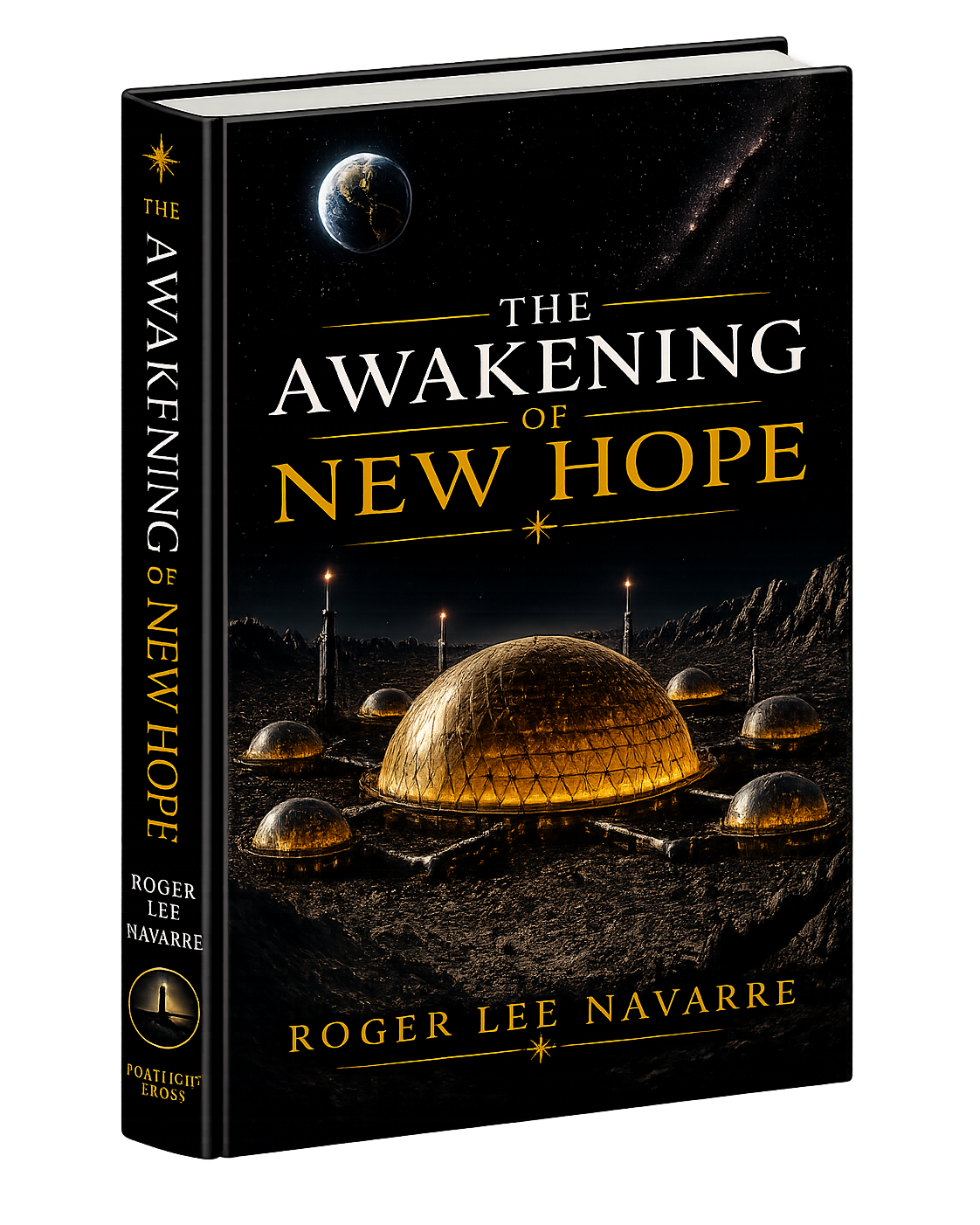
The Awakening of New Hope
A novel
A truth waiting to be heard.
On a lunar colony shaped by artificial perception and algorithmic control, one family discovers a silence that may restore what humanity has surrendered.
- Genre
- Hard Science Fiction
- Formats
- Paperback, EPUB, Audiobook
- Edition
- First Edition
Editions
Available formats
Paperback
Ordering opens when publication begins.
EPUB
Retailer links will appear here before publication.
Coming soon
Audiobook
Narrated edition in production.
Coming soon
From the book
Read an excerpt
Dense, black ash fell over Seattle, sticking to the glass of Caleb Vance’s ninetieth-floor apartment.
Rolling blackouts left the lower residential districts in darkness, and thick smog hid the wildfires burning beyond the city limits.
Inside the apartment, the environmental scrubbers hummed, maintaining the room at a steady 70 degrees Fahrenheit and one atmosphere.
Sitting on the edge of his couch, Caleb scrolled through the curated feeds of the Axiom-Lunar logistics network on his tablet.
Even though Axiom-Lunar still employed human executives, the algorithms made the actual decisions, commanding the automated factories to turn out new visors, scent cartridges, and software upgrades without pause.
Caleb swiped past catalogs of things he did not need—citrus scent cartridges, biometric sleep trackers, and serotonin lighting rigs—the useless advertisements flickering across his eyes.
He bought an acoustic dampener for the walls, hoping it would block the scrubbers, the factories, and the muffled coughing beyond the polymer wall panels.
The tablet pulsed with a confirmation text:
Transaction logged.
Acoustic dampener queued for deployment.
For exactly three seconds, Caleb felt better. The light faded, and the credits vanished from his ledger. The purchase cost weeks of wages, and his ledger flashed amber as the balance dropped toward zero.
He kept scrolling.
They had been married six years, and for the first four it had been a real marriage—Caleb still remembered it—having another person in the room who was not just background noise. He had been younger then, still capable of sitting across from her at a table, wondering what she was thinking instead of what she had bought.
The erosion had been so gradual he could not point to the exact moment it began. He suspected it began when Elena received her first haptic visor, a gift from the Axiom-Lunar subsidiary that employed her at the botanical station. He remembered watching her eyes change over time, her gaze settling just past his left ear to track a feed he could not see.
He had not objected. Several months later, he yielded to the inevitable and bought his own visor.
An earlier version of their life had included what remained of a church—a cold basement gathering in the lower residential district—but that ended when the rolling blackouts made the lower districts unsafe after dark.
What they had instead was proximity—living in the same apartment, spending from the same account, and occasionally crossing paths at the counter before their feeds absorbed them. Caleb could not say this was a bad life, nor could he say he was suffering; he was simply hollow, and the marketplace always seemed ready with another cure.
The empty corner of their living room remained the one thing the feeds had not managed to fill. For five years, Caleb and Elena had measured that space and then left it bare. They had already chosen names: Leo and Mia. The children were not born, not even promised, but Caleb had imagined them so often that he could almost see them there, breathing clean air beside soil that still grew things.
He had never said this to Elena. He did not know how to say it.
Hunched over a botanical station, Elena adjusted a nutrient drip line, trying to coax a single drop of water into the exhausted soil. A handful of silver thistles sagged in a shallow tray. Beside them, a young white oak drooped in its cultivation pot, its leaves yellowing.
She tapped the side of her nutrient scanner, but when its display continued flashing a zero, she dropped it onto the table and stared at the dying leaves.
Elena spoke to the nearby Axiom device. “Axiom, authorize emergency botanical intervention. Highest tier.”
Axiom-Lunar transaction approved.
Dispensing root-zone stimulant.
A mechanical arm extended from the botanical station, spraying a blue foam that bubbled around the base of the oak sapling before thickening into a hardened crust over the soil.
“I can’t keep it alive,” Elena murmured. “The ash is choking the light and the roots are collapsing. I keep buying supplements and nothing changes. How are we supposed to bring children into a world where even weeds won’t grow?”
Caleb looked up from the glowing screen. His eyes went to the empty corner of the living room, and then away.
Turning her back to the dying oak sapling, Elena slid her haptic visor over her eyes. As her posture slackened, a meadow reflected across her visor.
Caleb sat motionless on the couch, watching her fingers curl in the empty air as she tried to feel a simulated flower.
From the kitchen counter, the Axiom device pulsed blue and chimed:
Axiom-Lunar delivery confirmed.
Your atmospheric upgrades are en route to the foyer transit tube.
Caleb looked back down at his tablet, his thumb hovering over a catalog of insect-protein pastes.
Listening to the hum of the scrubbers, he watched the faint blue light of the visor shift across Elena’s pale skin.
“Did you authorize the transaction for the atmospheric upgrades, Elena?” he finally asked. She didn’t remove her visor. Her eyes kept tracking whatever it showed her.
Elena flicked two fingers through the air, and the meadow vanished, replaced by the reflection of a silver dome across her visor. “Marcus Thorne released a new promotional file for the lunar migration,” she murmured.
“He’s promising no rolling blackouts, Caleb. Just a dome with steady heat and air that doesn’t smell like smoke.”
Dropping the tablet onto the couch, he walked to the drafting table and pressed a stylus against the glass. Spread across the display were his designs for the new housing blocks—concrete bunkers with storm-rated walls and sealed air filtration that Thorne had ordered built fast.
Because of his early training in applied physics, Caleb saw every architectural wall as a negotiation between pressure, load, and the fragile people sheltering behind it.
Caleb knew the history of the old lunar mining stations—temporary outposts abandoned when Earth’s economy collapsed and the supply lines failed.
Now Marcus Thorne was promising something different: a civilian colony meant to last, governed by his Automated Resolution and Integrity System—ARRIS.
“Thorne wants to meet with me today,” Caleb said, staring at the lines of his concrete bunkers. “He asked for me by name to design the residential sectors.”
Elena pushed the visor up onto her forehead and looked at him fully for the first time in hours.
“Go to the meeting, Caleb,” she whispered. “The air is poison, and I can’t keep soil alive in our own apartment.”
Walking back to the couch, Caleb picked up his tablet, only to find the marketplace already displaying predatory ads for oxygen cartridges and synthetic sunlight.
Axiom-Lunar market update:
Synthetic sunlight increased by 5% due to rolling blackouts.
He powered the screen down, plunging the apartment back into amber emergency light.
“I’ll go,” Caleb said.
The transit tube in the foyer engaged with a hiss. As a cylinder slid into the receiving cradle, Elena opened it to reveal the atmospheric upgrade: a few aerosol cartridges and an emitter.
Carrying the hardware back to the kitchen counter, she snapped the first cartridge into the Axiom device’s manifold. The emitter flashed white, connecting to the network before the node chimed:
Ambient upgrade engaged.
Dispensing Pacific Rain simulation.
A thin mist smelling of wet earth and pine hissed into the living room.
Elena stood in the center of the room with her eyes closed, but the relief lasted only ten seconds before the vents engaged, sucking the remaining synthetic rain into the ventilation grates.
When the scent faded, the scrubbers took over again. She stared at the few remaining cartridges. Each one cost several days of Caleb’s wages. She closed the lid and pushed the box across the counter before she could justify using another.
Grabbing his coat and mask from the hook, Caleb turned toward the door. “I’m heading to Thorne Dynamics now,” he said.
Elena didn’t turn around. “The air quality index is red, Caleb. Take the transit.”
“I just need to walk,” Caleb replied, opening the door before she could answer.
He descended to ground level and stepped outside, where smog pressed low over the street. Ash from the wildfires coated the sidewalks, forcing Caleb to pull each breath through his mask’s heavy filters.
Hundreds of pedestrians moved with their heads bowed, their faces obscured by masks and their eyes locked onto tablets and haptic visors.
Dry ash crunched under his boots as a pedestrian clipped his shoulder, the man neither breaking stride nor looking up.
At a crosswalk, a traffic hub flashed a visual command into the smog, but no one looked up—the pedestrians merely followed the crossing prompts chiming inside their visors.
Caleb passed a ruined fountain where clean water no longer flowed, its basin now just a collection pit where soot drifted over empty scent cartridges and spent oxygen cells. Above the fountain, a New Hope advertisement showed two children laughing under a glass dome, their white clothes spotless.
Continuing toward Thorne Dynamics, a low vibration moved up through the pavement beneath Caleb’s boots, and as he stopped to listen, he counted the rhythm: four beats per second.
Praise
What others are saying
Navarre’s narrative ability to transform the reader’s view of "unfiltered reality" versus "engineered comfort" is masterful. By the end of the text, the reader understands that the "Proximity Filter" of modern life—the desire to edit out the pain and friction of the human experience—is the very thing that prevents us from finding our pulse. The Awakening of New Hope stands as a substantive, stand-alone resource for anyone seeking a "heartbeat" in a silent world, emphasizing that the Pulse is the ultimate differentiator between a functional system and a living civilization.
NotebookLM Reviews